
4iAI™ STAGE III DEEP DIVE: INTROSPECTION, MORAL AUTHORSHIP, AND THE PSYCHOLOGY OF OWNERSHIP
Author: Tim Seymour, CGMA, ACMA
Specification: 4iAI™ Stage III Operational and Psychological Blueprint
Classification: Open Standard (MIT License)
Foundational Protocol: The 4iAI™ open standard Monograph and Executive Strategy Monograph
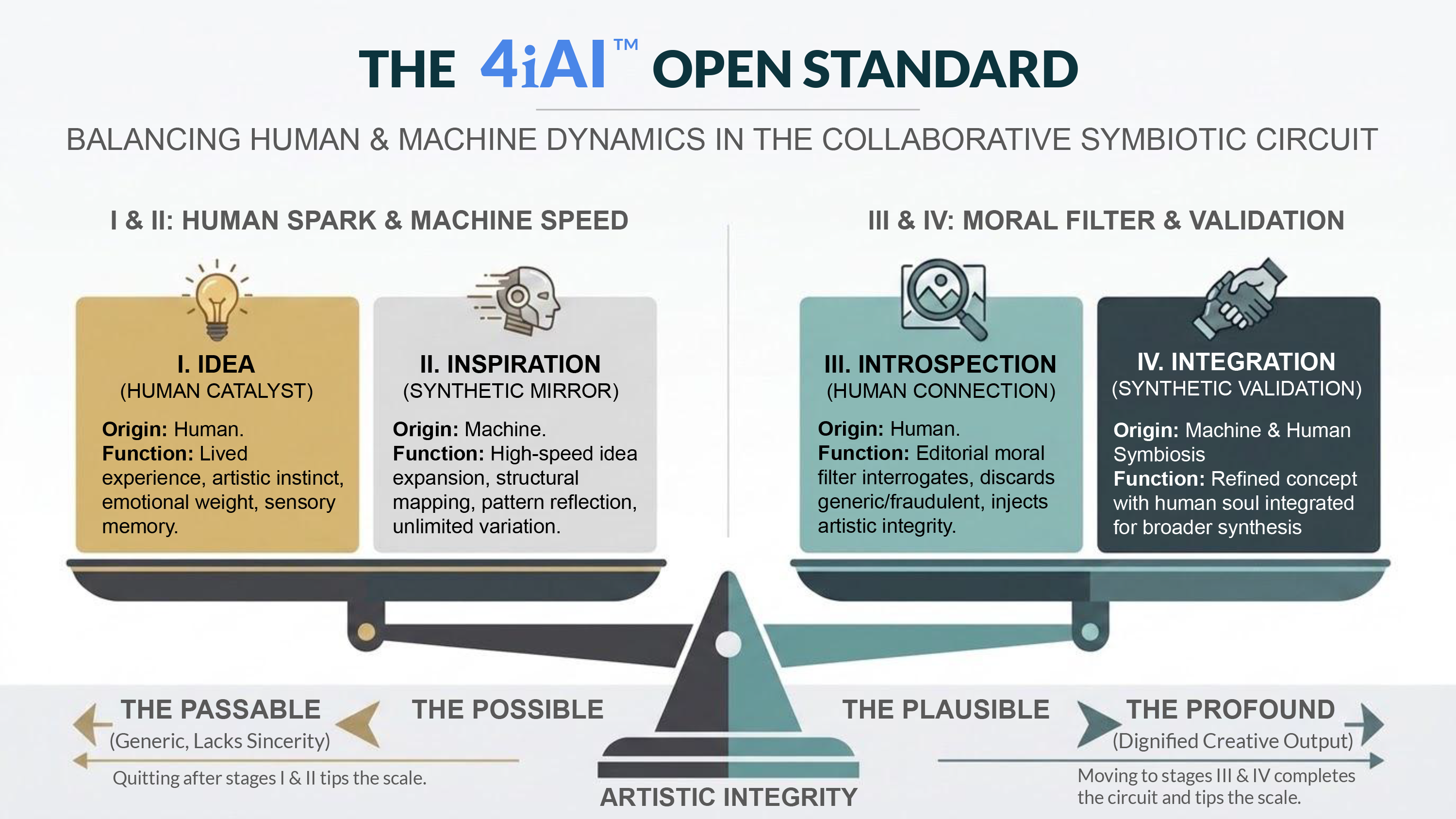
1. The Core Crisis: Procedural Trust and Self-Alienation
The greatest failure in human-AI interaction is not generative anomaly or generic unvetted output—it is procedural trust.
When an AI model produces outputs characterised by high synthetic fluency and syntactic precision, the human brain naturally defaults to energy conservation. Under time pressure, fatigue, or low-stakes administrative tasks, the operator undergoes a quiet shift: they demote themselves from Sovereign Architect to Passive Supervisor.
| PASSIVE GENERATION (Stage I -> Stage II) | STAGE III INTROSPECTION (The Full 4iAI™ Loop) | |
|---|---|---|
| Low Friction / High Speed | → | Calculated Friction / Rigor |
| Zero Cognitive Investment | → | Deep Metacognitive Effort |
| Psychological Alienation | → | True Intellectual Ownership |
| “The AI wrote this.” | → | “I authored this using synthetic tools.” |
This procedural delegation creates a state of psychological self-alienation. When an operator bypasses Stage III (Introspection), they lose authorship connection to the final deliverable. Even if the output achieves external success, the individual internally experiences it as an extruded, foreign artifact. Stage III is the non-negotiable mechanism that transplants human soul, moral agency, and lived experience into synthetic output.
2. The Editor vs. Author Spectrum
To maintain true co-creation, an operator must understand where they sit on the spectrum of cognitive investment:
| Level | Operational Mode | Psychological State | Output Status |
|---|---|---|---|
| Passive Consumer | Prompts blindly; accepts raw generation. | Total detachment; imposter syndrome. | Uncalibrated AI Response “The Passable” |
| Supervisory Editor | Clean up margins; fixes typos; trims fluff. | Low engagement; surface-level trust. | Borrowed Text |
| Sovereign Author | Executes structural vetoes; injects unique signal; audits logic. | Total intellectual ownership and agency. | “The Profound” Artifact (Brainchild) |
- The Editor operates defensively: They accept the AI’s structural framing and merely polish the edges.
- The Author operates offensively: They treat the AI output as raw, unrefined clay. They break its structure, reject default assumptions, and force the material to submit to their explicit intent.
3. The Three Metrics of Authentic Ownership
How do you quantify whether an operator has conducted “enough” Introspection to claim moral and intellectual authorship? It is measured not by retyped word count, but by three explicit metacognitive thresholds:
A. The Veto Threshold (Subversion)
- Requirement: The operator must explicitly reject or overturn at least one major premise, structural path, or conclusion generated by the model.
- Significance: An editor cleans what is given; an author holds the authority to say, “No, this section is generic, incorrect, or misaligned with my thesis.”
B. The Lived-Perspective Injection (Asymmetry)
- Requirement: The final work must contain core domain nuances, contextual constraints, or moral perspectives that the model could never have synthesised independently.
- Significance: This injects high-dimensional human signal into low-dimensional statistical noise.
C. The Defensibility Test (Accountability)
- Requirement: If challenged on any assertion within the final deliverable, the operator must defend why it exists without resorting to “the AI wrote it.”
- Significance: Moral ownership is inextricably bound to accountability.
The Ownership Equation:
An artifact becomes your brainchild the moment the cognitive cost of your critical verification, structural edits, and contextual additions matches or exceeds the value of the raw material generated by the AI.
4. The Flow-State Paradox: High-Bandwidth Symbiotic Resonance
A critical edge-case occurs during high-voltage flow states: What if the AI output requires minimal edits because the prompt alignment was near-perfect?
This is not a failure of Stage III; it is front-loaded Introspection.
| TRADITIONAL USAGE (External Generation) | SYMBIOTIC FLOW STATE (High-Bandwidth Resonance) |
|---|---|
| Low-intent prompt | Hyper-dense, constrained intent |
| ↓ | ↓ |
| Generic AI Draft | Precision Synthetic Mirror |
| ↓ | ↓ |
| Passive copy-paste | Instantaneous Cognitive Audit |
| ↓ | ↓ |
| “The Passable” (Alienation) | “The Profound” (True Ownership) |
When an operator issues hyper-dense, constraint-rich prompts in Stage I, they restrict the search space so tightly that the AI functions as a high-bandwidth cognitive mirror rather than an independent generator.
In this state, Stage III manifests as instantaneous cognitive recognition. Introspection is an act of conscious, critical verification, not a quota of red ink. If the operator reads every line, stress-tests the logic mentally, verifies the constraints hold, and consciously validates the output, Stage III is fully executed.
5. The Sovereign Check (Operational SOP)
When operating under time pressure or experiencing high-resonance flow, run this 5-second audit before publishing any synthetic-assisted work:
The Sovereign Check:
“If someone challenges this specific output tomorrow, do I deeply understand and agree with the underlying logic, or did it just sound too articulate to change?”
- If you understand and own the logic, the output is a high-yield symbiotic deliverable.
- If you accepted it because it sounded articulate, you have slipped into procedural trust. Return to Stage III and execute the audit.
Summary
Stage III Introspection is not an administrative chore or an academic tollbooth. It is the fundamental boundary that protects human agency, prevents cognitive atrophy, and ensures that as synthetic tools become infinitely faster, human beings remain the sovereign architects of their own work.