
CURRICULUM OPEN STANDARD: THE 4iAI™ COGNITIVE ACCELERATOR
Target Audience: Secondary and Higher Education (STEM, Humanities, Business)
Core Objective: Shift student behaviour from passive consumption (“The Passable”) to active intellectual ownership (“The Profound”).
Grading Philosophy: Students are graded not on the initial AI output, but on the quality and depth of their Stage III Introspection and final human calibration.
Foundational Protocol: The 4iAI™ open standard Monograph and Education Monograph: The 4iAI™ Introspection Protocol
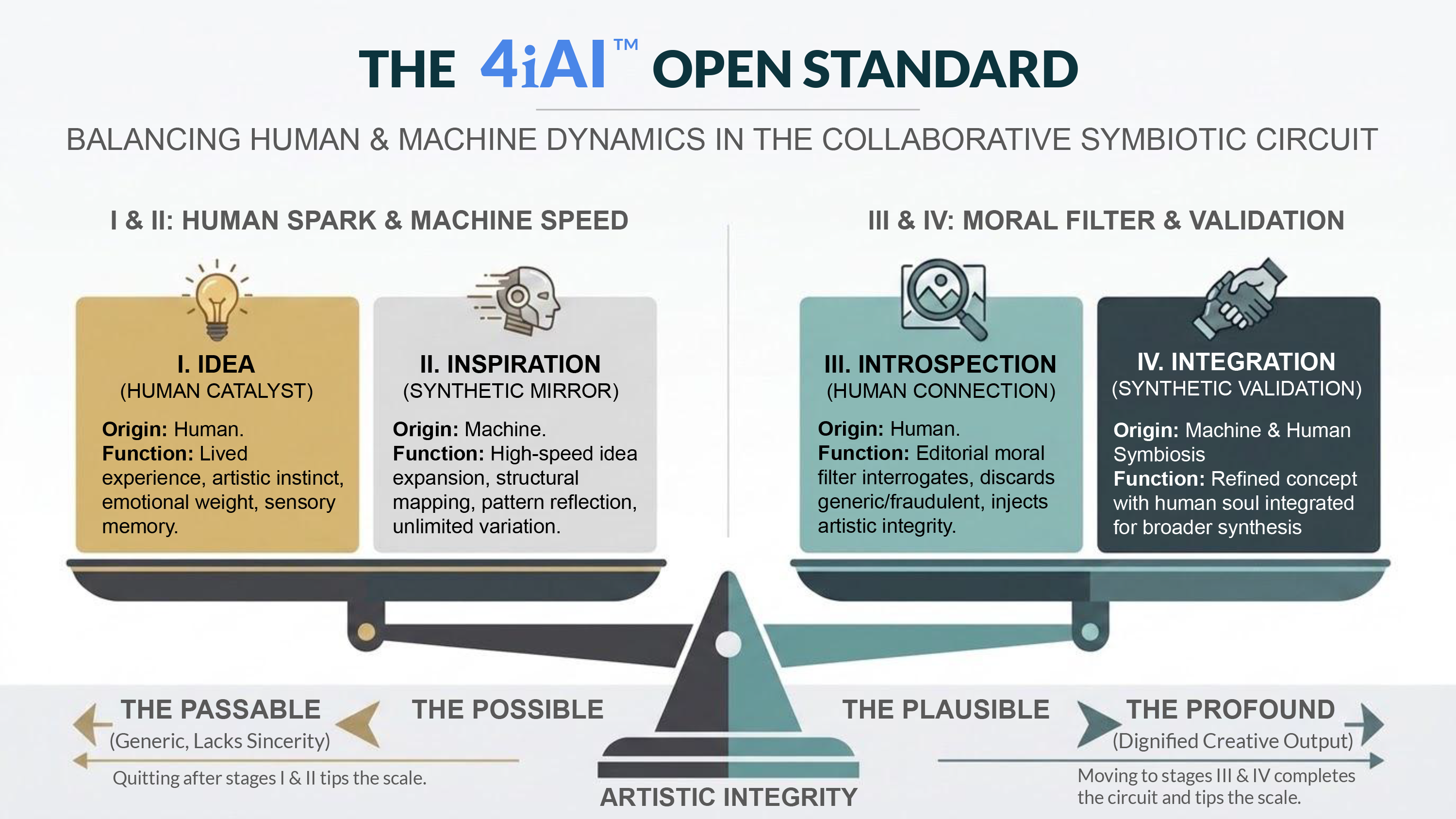
The Paradigm Shift: Reframing the AI Assignment
| Traditional Assignment (Broken) | The 4iAI™ Assignment Standard |
|---|---|
| Goal: Produce a final written document. | Goal: Demonstrate the intellectual journey from draft to verification. |
| AI Role: Secret shortcut or outright banned tool. | AI Role: Stage II “Inspiration Engine” and Dialectical Mirror. |
| Student Role: Transcriber / Copy-Paster. | Student Role: Lead Architect, Editor, and Truth Filter. |
| Evidence: The final text block. | Evidence: The Introspection Audit Log + Calibrated Deliverable. |
The 4-Stage Classroom Cycle
Stage I: Idea (Human Catalyst): Student sets the hypothesis and boundaries.
The student formulates a core hypothesis, research question, or creative concept before touching an AI interface.
- Student Action: Write a 3-sentence “Core Intent Statement” defining what they want to solve or prove, including explicit constraints, domain context, and personal perspective.
- Rule: No prompts may be issued until Stage I is documented.
Stage II: Inspiration (Synthetic Mirror): Generating high-density baseline raw material.
The student uses generative AI to produce an initial baseline, rapid synthesis, or alternative perspectives.
- Student Action: Issue the Stage I prompt to the AI.
- Output Captured: The raw, unedited AI output (the “Baseline Draft”).
- The Trap Identified: Recognizing that stopping here yields only “The Passable”—generic, uncalibrated, and prone to hallucinations.
Stage III: Introspection (The Human Truth Filter): The core graded learning activity.
The student subjects the Stage II output to rigorous critique, factual verification, tone alignment, and logical stress testing.
-
Student Action: Complete the Introspection Audit using three mandatory lenses:
- Fact and Source Verification: Identify 3 specific assertions made by the AI. Find primary or secondary sources that either confirm or debunk them.
- Bias and Hallucination Spotting: Highlight generic filler, unstated assumptions, or structural gaps in the AI’s logic.
- Voice and Personal Synthesis: Identify where the AI output strays from the student’s original Stage I intent.
Stage IV: Integration (The Profound Artifact): Final human-driven deliverable.
The student merges their Stage III audit with the raw material to construct the final work.
- Student Action: Submit the final deliverable alongside the 4i Log (Idea, Raw Prompt, Introspection Audit, Final Integration).
- Evaluation Metric: 60% of the assignment grade is awarded directly for the depth and accuracy of the Stage III Introspection Audit.
Practical Classroom Tool: The Introspection Audit Template
To operationalize this in daily coursework, students attach this standardized 1-page table to every submission:
4iAI™ INTROSPECTION AUDIT LOG:
[STAGE I: MY INTENT]
“What was my original position, question, or goal before using AI?” →
[STAGE II: RAW AI OUTPUT SUMMARY]
“What did the AI generate? (Attach raw output as Appendix A)” →
[STAGE III: INTROSPECTION AND CRITIQUE]
| AI Assertion / Claim | Verification Status (True/False) | Source Evidence or Logical Correction |
|---|---|---|
| 1. | [ ] Verified [ ] Hallucination | |
| 2. | [ ] Verified [ ] Hallucination | |
| 3. | [ ] Verified [ ] Hallucination |
[MY EDITORIAL CALLS]
“What generic AI phrasing did I actively cut / enhance?” →
“What critical angle did the AI completely miss that I added?” →
[STAGE IV: FINAL INTEGRATION]
(Attach final calibrated work)
Expected Outcomes
- Elimination of Copy-Paste: Copy-pasting AI output becomes impossible because the grade relies on demonstrating where the AI was wrong, incomplete, or generic.
- Building Critical AI Literacy: Students learn early that AI models are statistical prediction machines, not infallible authorities.
- Metacognitive Growth: By forcing students to explain why they rejected or edited a piece of AI output, they gain a deeper understanding of the subject matter than traditional rote writing allowed.