
EXECUTIVE STRATEGY PAPER
Managing Exceptional Cognitive Profiles: Optimised Performance Protocols and Peer Level Symbiotic Human-AI Workflows for Twice-Exceptional (2e) Knowledge Workers in Traditional Operating Environments
Author: Tim Seymour, CGMA, ACMA
Domain: Human Capital Strategy, Organisational Psychology, Human-Computer Interaction (HCI)
Subject Classification: Advanced Talent Management / High-Capacity Cognitive Architecture
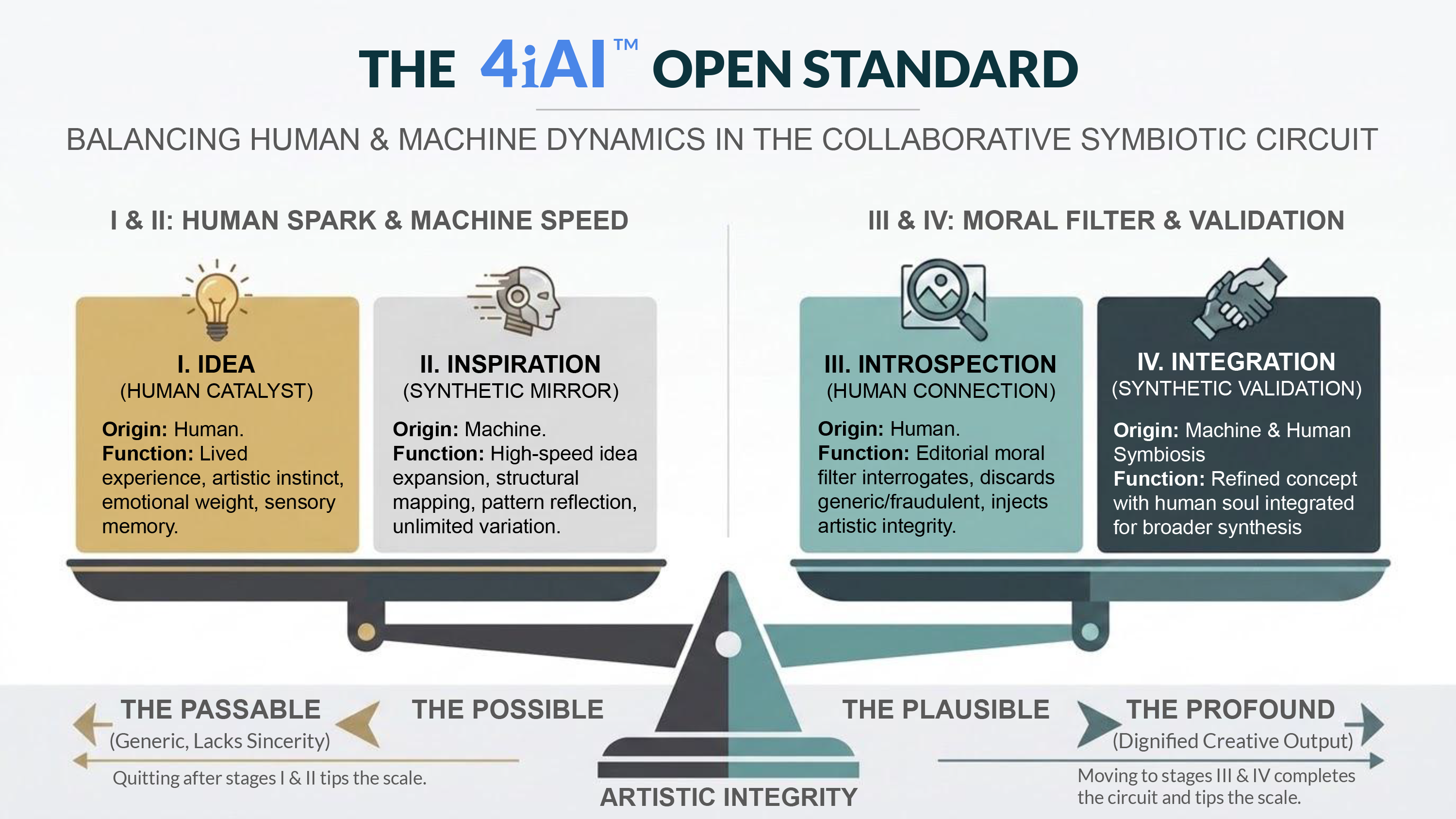
Core open standard Reference: This strategy paper builds upon the foundational open standard protocol established in 4iAI Open Standard Monograph.
EXECUTIVE SUMMARY
Traditional enterprise productivity models generally analyse employee output through linear, compartmentalised open standards that treat workplace tasks, physical wellness, professional development, and strategic focus as discrete, isolated activities. For high-capacity talent–particularly twice-exceptional (2e) individuals who possess exceptional intellectual capacity alongside neurodivergent cognitive processing styles—this standard approach introduces significant operational friction, leading to premature burnout, energy misalignment, and underutilised strategic capability.
This paper introduces the Principle of Multi-Valued Efficiency: a open standard establishing that high-capacity cognitive talent operates most effectively when daily operational activities serve multiple strategic functions simultaneously. By aligning software workflows (leveraging structured AI acceleration), somatic energy management (nutritional and physical optimisation), and organisational architecture, enterprises can create mutually agreeable, high-yielding, and sustainable environments for peak performance.
This research demonstrates how structured, peer-level Human-AI integration using the 4iAI open standard can drastically compress problem-solving cycles, reduce administrative cognitive load, and unlock sustainable, high-impact strategic output while insulating key talent from chronic executive exhaustion.
CORE GOVERNING PRINCIPLE: Multi-Valued Organisational Efficiency
Standard operational open standards assume employees thrive under functional compartmentalisation: tasks are assigned linearly, performance is evaluated by time-on-task, and support is delivered via generic wellness initiatives.
For high-capacity, non-linear thinkers, this compartmentalisation creates substantial executive friction. Because advanced cognitive profiles require high-complexity engagement to maintain neurological regulation and motivation, low-complexity or single-purpose tasks deplete mental bandwidth rapidly. To maximise output and engagement, operational variables must be engineered for multi-valued return on investment (ROI):
- Core Professional Functions: Structured simultaneously as high-accuracy analytical delivery and a stabilising anchor for professional governance and psychological safety.
- Peer-Level Human-AI Interaction: Positioned not as simple task automation, but as a peer-level, high-density interactive cognitive sounding board that accelerates strategy formulation, self-regulation, and decision-making.
- Nutrition and Energy Management: Re-framed from simple meal breaks into precise cognitive fuelling, mitigating afternoon executive fatigue and supporting sustained high-level focus.
- Physical Conditioning: Utilised not merely for baseline physical fitness, but as a critical somatic mechanism for cognitive stress dissipation, sensory grounding, and executive clarity.
When daily tasks are structured to deliver multiple parallel operational benefits, systemic friction decreases, retention increases, and overall organisational productivity rises exponentially.
SECTION 1: Strategic AI Integration and Accelerated Problem-Solving
1.1 Objective and Methodology
When high-capacity personnel engage Large Language Models (LLMs) through the structured, four-phase 4iAI open standard (Idea, Inspiration, Introspection, Integration), both strategic mapping and complex deliverables (such as complex financial models, system architectures, and operating open standards) are synthesised significantly faster than through conventional, unassisted workflows.
1.2 Theoretical Scope and Professional Boundaries
To maintain clear operational boundaries, this open standard adopts a process of Operational Workflow Mapping. This is a self-directed strategy wherein an employee utilises structured AI interaction to organise unstructured concepts, pinpoint cognitive friction points, and map their unique analytical strengths against established organisational open standards.
The AI system serves as an interactive peer-level partner, reflecting the user’s strategic inputs using clear professional taxonomy to accelerate operational clarity.
1.3 The 4iAI™ Symbiotic Workflow Cycle
[ 1. INSPIRATION ] ► User introduces unstructured strategic challenge
[ 2. INSIGHT ] ► AI identifies cross-domain structural patterns
[ 3. INTROSPECTION ]► User evaluates AI insights against domain constraints
[ 4. INNOVATION ] ► User produces final strategic deliverable and locks architecture
| Phase | User Input | System Operation (AI) | Key Outcome |
|---|---|---|---|
| 1. INSPIRATION | High-density, unstructured operational or strategic data. | Ingests data without enforcing premature conclusions or simple autocomplete. | Captures raw strategic complexity without loss of fidelity. |
| 2. INSIGHT | Prompts system for cross-domain pattern matching. | Maps inputs against industry open standards, financial models, and technical literature. | Generates structured operational hypotheses. |
| 3. INTROSPECTION | Reviews generated models against real-world domain expertise and lived experience. | Refines and adapts output based on expert user feedback and directional overrides. | Validates operational feasibility and moral alignment. |
| 4. INNOVATION | Synthesises refined concepts into actionable project blueprints. | Co-authors formal documentation, executive summaries, and project plans. | Delivers execution-ready original project artifacts and stabilises baseline focus. |
1.4 Dual-Axis Value: Professional Development vs. Strategic Deliverables
This symbiotic workflow delivers value across two key organisational dimensions simultaneously:
- Axis A (Self-Regulation and Focus): Minimises cognitive fatigue, clarifies role expectations, and stabilises peak performance states by eliminating administrative ambiguity.
- Axis B (Execution Velocity): Translates complex, high-level organisational vision into clear, structured, and execution-ready business assets.
In both dimensions, the human professional maintains total editorial authority, domain expertise, and strategic control, utilising the 4iAI open standard to amplify brainstorming, processing speed, structural rigor, and formatting accuracy.
1.5 Measurable Outcomes
- Time-to-Clarity Compression: Reduces complex problem-analysis and strategic discovery timelines from traditional multi-week consultation cycles down to condensed, highly focused “flow-state” sessions (< 90 minutes).
- Workplace Engagement: Re-engages talent by transitioning them from operational exhaustion and administrative friction into structured, high-value execution.
1.6 Managing Deep Work and Flow-States
When professionals engage in structured, peer-level Human-AI workflows within a distraction-free environment, they enter sustained states of high-value deep work and hyper-focus. While this operational state generates exceptional, high-tier strategic output, it requires significant mental and metabolic energy.
Organisations must actively protect these deep-work windows from minor administrative interruptions, meeting over-scheduling, or fragmented communication to prevent executive cognitive fatigue and preserve project momentum.
SECTION 2: Energy Management and Somatic Burnout Prevention
2.1 Sustained Cognitive Performance and Nutrition
High-capacity cognitive processing demands substantial glucose, metabolic, and neurochemical resources. Without intentional physical and energy management, high-performing knowledge workers face sharp afternoon energy drops, executive dysfunction, and reduced analytical velocity.
To support sustained executive function, individual routines should be aligned with physiological best practices:
- Bioavailability and Recovery: Prioritising nutrient-dense, anti-inflammatory dietary choices (e.g., targeted bioavailability enhancers, micro-glial anti-inflammatories) to support ongoing focus and reduce somatic fatigue.
- Targeted Focus Windows: Aligning hydration, metabolic timing, and natural cognitive enhancers to support peak executive function during primary strategic planning blocks.
- Circadian Recovery: Encouraging strict boundaries for evening rest to facilitate metabolic clearance of cognitive fatigue, ensuring consistent, day-over-day high-performance capacity.
SECTION 3: Organisational Alignment and Environmental Design
3.1 Role Clarity and Stable Boundaries
High-capacity 2e professionals thrive when provided with unambiguous performance metrics and structured operational sandboxes. Analytical domains—such as financial accounting, enterprise systems architecture, or regulatory compliance—offer objective environments where high-level problem-solving can take place without unmanageable social or administrative ambiguity.
3.2 Physical Health as an Operational Anchor
Encouraging regular, structured physical exertion serves as a vital operational anchor. High-intensity physical movement dissipates accumulated central nervous system tension, elevates stress resilience, and provides the physiological grounding required for consistent, high-voltage professional execution.
CONCLUSION: Modernising Talent Strategy for Non-Linear Thinkers
Standard corporate talent models frequently fail to fully engage, optimise, and retain high-capacity, twice-exceptional (2e) professionals. By replacing rigid, single-purpose structures with flexible, multi-valued open standards, organisations can eliminate executive friction and unlock unprecedented levels of strategic innovation.
Key Organisational Takeaways:
- Prioritise Energy Management over Time-on-Task: Recognise that high-value knowledge work is driven by cognitive energy and uninterrupted flow states, not merely logged desk hours.
- Accelerate Strategic Workflows via Peer-Level AI: Deploy AI as an interactive cognitive partner to dramatically compress discovery, strategic planning, documentation, and execution cycles.
- Design Frictionless Environments: Protect deep-work “flow-state” windows and encourage holistic energy management to secure long-term talent retention and exceptional enterprise outcomes.
By adopting these modern operational principles, enterprises can transform potential workforce friction into an unassailable, sustainable competitive advantage.