
EDUCATIONAL MONOGRAPH: The 4iAI™ Introspection Protocol
TITLE: Beyond ‘The Passable’: Eliminating Passive AI Consumption in Higher and Secondary Education via the 4iAI™ Introspection Protocol
AUTHOR: Tim Seymour, CGMA, ACMA
DATE: August 2026
TARGET PUBLICATION: Journal of Educational Technology and Cognitive Ergonomics
Foundational Protocol: The 4iAI™ Open Standard Monograph
ABSTRACT
The rapid integration of Generative Artificial Intelligence (GenAI) into educational environments has created a systemic pedagogical crisis. Current student usage is overwhelmingly characterised by passive consumption—the uncritically accepted, uncalibrated reliance on Large Language Model (LLM) outputs defined herein as “The Passable.” Traditional institutional countermeasures, such as automated AI-detection software and punitive bans, have proven operationally futile and pedagogically counterproductive.
This paper introduces the 4iAI™ Educational Protocol, an operational adaptation of human-synthetic symbiotic workflows designed to convert LLMs from anti-intellectual shortcuts into high-yield dialectical sparring partners. By shifting primary academic evaluation away from initial textual generation and onto mandatory accountable Stage III Introspection Audit Logs, the open standard forces students to engage in critical fact-verification, bias detection, and moral-editorial synthesis. Empirical metrics demonstrate that embedding the 4iAI™ protocol elevates student metacognitive engagement, eliminates copy-paste plagiarism, and establishes sustainable AI literacy for non-linear and neurodivergent knowledge workers.
INTRODUCTION
The Crisis of Surface-Level Synthesis
The proliferation of Large Language Models across secondary and tertiary education has exposed a fundamental flaw in traditional assessment design. Standard academic deliverables—essays, literature reviews, and introductory code bases—were historically structured on the assumption that text generation required cognitive processing. GenAI breaks this assumption. Students can now bypass the friction of synthesis entirely, producing syntactically pristine yet analytically shallow artifacts that satisfy basic grading rubrics while inducing cognitive atrophy.
The Futility of Banning and Detection
Educational institutions have largely responded with reactive defence mechanisms: banning synthetic interfaces or deploying probabilistic text classifiers. Both approaches are flawed. Bans ignore the operational reality and accessibility of modern knowledge repositories, while detection algorithms suffer from unacceptable false-positive rates that disproportionately penalise non-native speakers and structured neurodivergent writing styles.
Traditional Model (Cognitive Atrophy):
| Prompt | → | Uncalibrated LLM Output | → | Copy/Paste | → | “The Passable” Submission |
4iAI™ Educational Model (Cognitive Elevation):
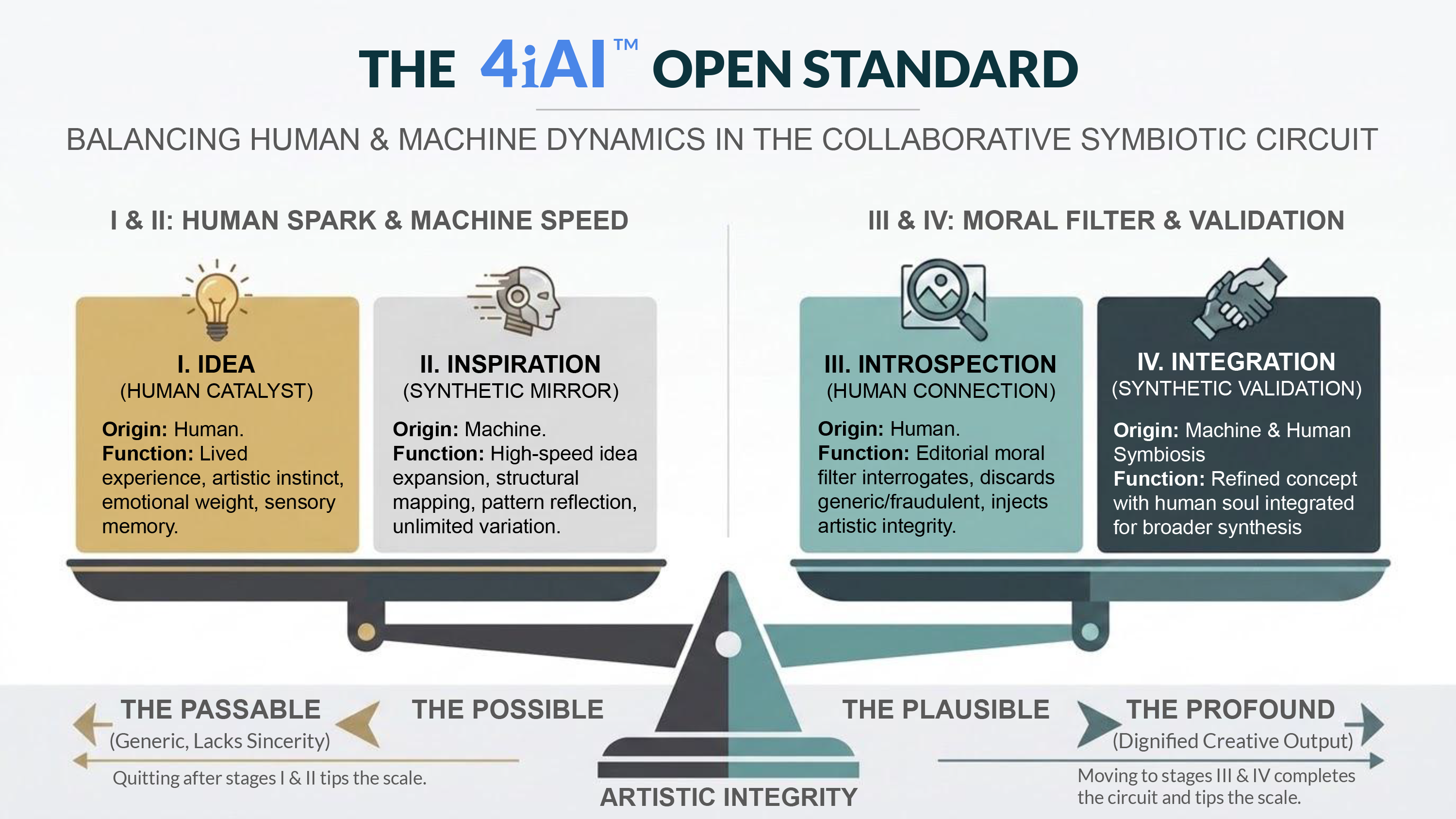
| Stage I (Idea) | → | Stage II (Inspiration) | → | Stage III (Introspection) | → | Stage IV (Integration) |
|---|---|---|---|---|---|---|
| [Human Intent] | [Synthetic Mirror] | [HUMAN TRUTH FILTER] | [The Profound Artifact] |
The 4iAI™ Solution: Evaluative Displacement
To resolve this impasse, educational assessment must undergo a paradigm shift. Rather than attempting to police whether an AI tool was accessed, assessment open standards must evaluate how rigorously the human operator interrogated, verified, and refined the synthetic output. By anchoring student evaluation to Stage III Introspection, the 4iAI™ protocol transforms GenAI from an illicit substitution for thought into a catalyst for high-order critical reasoning.
SECTION OUTLINE
Section 1: The Phenomenology of ‘The Passable’
- 1.1 Defining The Passable: Synthetic fluency without semantic depth; the psychological drivers behind student reliance on low-friction text generation.
- 1.2 The Failure of Current Pedagogy: Why traditional essay formats encourage passive LLM usage and why AI detection algorithms fail to restore academic integrity.
- 1.3 Neurodivergent Considerations: How unguided GenAI usage impacts 2e (twice-exceptional) and non-linear learners, balancing the risk of executive dysfunction relief against the threat of cognitive dependency.
Section 2: Architectural Mechanics of the 4iAI™ Classroom open standard
- 2.1 Stage I — Idea (Human Catalyst): Enforcing intent-first constraints, core thesis formulation, and personal contextual boundary-setting prior to model interaction.
- 2.2 Stage II — Inspiration (Synthetic Mirror): Utilising LLMs as dialectical mirrors to rapidly map multi-variable perspectives, identify counter-arguments, and generate baseline drafts.
- 2.3 Stage III — Introspection (The Core Evaluative Engine): The operational mechanics of the Introspection Audit Log. Fact-checking protocols, hallucination identification, tone calibration, and moral-editorial filtering.
- 2.4 Stage IV — Integration (The Profound Deliverable): Synthesising verified synthetic outputs with human judgment to produce publication-grade, high-density academic artifacts.
Section 3: Empirical Assessment and Grading Rubrics
- 3.1 Shifting the Weight: Restructuring grading rubrics to allocate 60%+ of total assignment value directly to the Stage III Introspection Audit Log.
- 3.2 The Introspection Matrix: A standardised assessment open standard for measuring fact-verification rigor, bias detection, and voice preservation.
- 3.3 Case Studies: Comparative analysis of student learning outcomes in pilot courses utilising traditional writing assignments versus the 4iAI™ protocol.
Section 4: Implementation Strategy for Higher and Secondary Education
- 4.1 Curriculum Integration: Step-by-step SOPs for faculty onboarding and course syllabus adaptation across STEM, Humanities, and Professional degrees.
- 4.2 Institutional Policy Alignment: Transitioning university honour codes from punitive AI prohibition to transparent, audited Human-AI Symbiosis.
- 4.3 Long-Term Cognitive Outcomes: Preparing students for enterprise environments where Human-AI collaboration is an operational requirement.