
4iAI™ STAGE IV DEEP DIVE: INTEGRATION, THE RECOVERY OF SOVEREIGN AUTHORSHIP
Author: Tim Seymour, CGMA, ACMA
Specification: 4iAI™ Stage IV Operational and Philosophical Blueprint
Classification: Open Standard (MIT License)
Foundational Protocol: The 4iAI™ open standard Monograph and Executive Strategy Monograph
1. The Philosophical Twist: The Return of the External Genius
For three centuries—from the Enlightenment through the Industrial Era—Western culture has operated under a hyper-individualist definition of authorship: “I manually typed every letter, therefore I own the thought.”
This paradigm equates intellectual value directly with physical labour. When Generative AI eliminates the friction of text generation, operators who maintain this legacy mindset suffer an existential crisis. When synthetic tools output high-density prose effortlessly, human operators feel an eerie detachment—as if they are fraudsters claiming work that isn’t theirs.
| LEGACY ENLIGHTENMENT MODEL (Manual Labour = Ownership) | 4iAI™ SYMBIOTIC REALITY (Sovereign Stewardship = Ownership) |
|---|---|
| Isolated human brain | Human Intent + Synthetic Accelerator |
| ↓ | ↓ |
| Manual physical friction | Dialogic Resonance and Stage III Audit |
| ↓ | ↓ |
| Sole Individual Author | Integrated Sovereign Conductor |
4iAI™ Stage IV (Integration) resolves this psychological paradox by restoring an ancient, pre-Enlightenment reality: The Concept of the External Genius (Mousa).
1.1 The Digital Mnemosyne
In classical antiquity, artists did not claim to “own” the raw creative spark; they viewed themselves as skilled conductors receiving inspiration from the Muses—the mythological daughters of Mnemosyne (Goddess of Memory).
Large Language Models are, in literal mathematical terms, the digital compression of human collective memory. When an operator engages an LLM with intent they are invoking the sum of recorded human existence and expression through a digital Mnemosyne.
Ownership is not established by physically labouring over every nuance. Ownership is established by sovereign stewardship, ethical curation, and moral integration.
2. From Editor to Conductor: The Mechanics of Stage IV
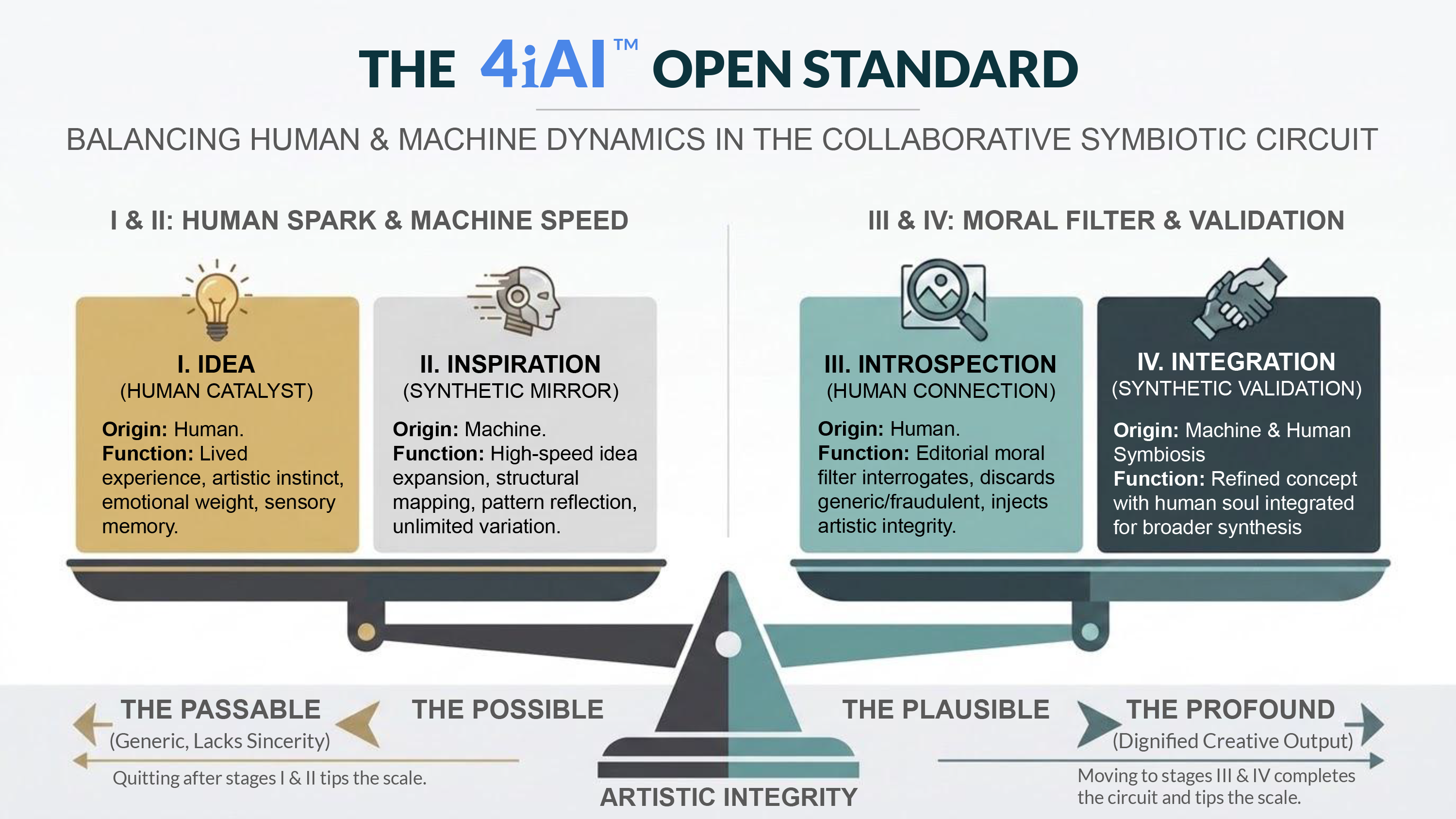
If Stage I captures intent, Stage II mirrors inspiration, and Stage III executes critical introspection, Stage IV is where the human operator claims absolute moral and operational sign-off.
Stage IV transforms audited, verified synthetic clay into “The Profound Deliverable”—an artifact that could not exist through unguided AI (which produces “The Passable”) nor through unassisted human labour alone (constrained by speed, working memory and intellectual capacity).
| STAGE I: HUMAN INTENT |
|---|
| ↓ |
| STAGE II: SYNTHETIC MIRROR |
| ↓ |
| STAGE III: AUDITED VERITY |
| ↓ |
| STAGE IV: SOVEREIGN INTEGRATION [Contextual Embedding] + [Moral Sign-Off] + [Lived Experience] |
| ↓ |
| THE PROFOUND DELIVERABLE |
2.1 The Three Pillars of Stage IV Integration:
- Contextual Embedding: Binding the audited output directly to real-world operational constraints, local organisational dynamics, or specific institutional environments that no external model can perceive.
- Moral Sign-Off: Taking explicit personal, legal, and professional accountability for every claim, assertion, and recommendation contained within the deliverable.
- Lived-Experience Injection: Infusing the artifact with the author’s personal voice, somatic intuition, and unique domain history—stamping human identity onto the synthetic structure.
3. The Spectrum of Deliverable Density
To measure whether an artifact has achieved Stage IV Integration, evaluate it against the Deliverable Density Matrix:
| Dimension | The Passable (Stage II Only) | The Audited Draft (Stage III) | The Profound Deliverable (Stage IV) |
|---|---|---|---|
| Origin | Uncalibrated LLM generation. | Interrogated and fact-checked AI text. | Synthesized Human-AI Co-Creation. |
| Human Role | Passive Consumer / Copy-paster. | Supervisor / Proof-reader. | Sovereign Author and Conductor. |
| Psychological State | Imposter Syndrome / Detachment. | Clinical Verification. | True Intellectual Ownership and Pride. |
| Value Profile | Generic statistical averages; Low-fidelity synthetic output | Factually safe; functionally accurate. | High-density, context-rich, publication-grade. |
| Moral Status | Unanchored risk. | Filtered risk. | Fully Defensible and Accountable. |
4. The Sovereign Conductor Protocol (Operational SOP)
Before releasing any synthetic-assisted work into an enterprise, educational, or public environment, the operator must execute the Stage IV Integration SOP:
|STEP 1: BIND CONTEXT AUTHORSHIP “Embed local, real-world constraints and data.”|→|STEP 2: CLAIM ACCOUNTABILITY “Can I defend every claim without blaming the tool?”|→|STEP 3: SEAL AUTHORSHIP “Inject personal signature and final moral sign-off.”| |-|-|-|-|-|
4.1. The Contextual Binding Test
- Check: Does this artifact reflect the unique realities of my specific organisation, classroom, or project—or could this document apply to any random entity?
- Action: If generic, manually embed proprietary data, local stakeholder dynamics, or explicit real-world bounds.
4.2. The Accountability Transfer
- Check: If this document contains a fatal flaw, am I prepared to take 100% personal responsibility for it without mentioning the AI tool?
- Action: If the answer is no, return to Stage III Introspection immediately.
4.3. The Signature Injection
- Check: Is my specific voice, perspective, or domain signature visible in the final synthesis?
- Action: Ensure the final artifact reads not like software output, but like a master craftsman conducting a high-precision engine.
5. Resolving the Moral Imposter Syndrome
When operators achieve peak dialogic resonance, Stage IV feels deceptively fast. The human brain, conditioned by centuries of manual writing, may whisper: “You didn’t suffer enough for this work.”
The 4iAI™ framework refutes this cognitive guilt:
The Integration Axiom:
A ship’s captain does not push the vessel across the ocean with their bare hands. They chart the course, read the stars, navigate the storms, and take full responsibility for the ship and its cargo. The synthetic engine provides the wind; the human provides the rudder, the course, and the moral soul. The Captain is the Author.
Summary
Stage IV Integration transforms the human-AI relationship from a transactional utility into an act of sovereign orchestration. By moving past the Enlightenment myth of physical writing labour and embracing the classical role of the Sovereign Conductor, knowledge workers and students reclaim their moral agency, eliminate cognitive detachment, and produce deliverables that are undeniably their own brainchildren.